Monday, November 11, 2013

Mariano Rangel: Merida Sculptor Carves Life into Wood


Mariano Rangel is a Venezuelan folk artist from Tabay, Merida, and something of a local legend. Born in 1944, he is completely self-taught. He worked as a farmer until 1984, when one day his wife asked him for help to finish a wood carving of the Virgin of the Immaculate Conception.

The idea of creating the image had come to her in a dream, she said. The Virgin had appeared to her in person, so this was no mere whim, but an obligation that needed to be met.

Mariano was working in the fields at the time, driving a plough with oxen and pulling potatoes out of the soil with his big, strong hands.

After work he would try and help his wife with the carving. Neither of them had ever carved anything before, but she was determined it must be done, and he seemed to have a natural instinct.for working the wood.

By the time the Virgin was finished and painted, Mariano realized he had a natural affinity for carving and wanted to do more. Over the years he gradually perfected his skills, took on larger and more ambitious projects, and his makeshift workshop became a magnet for national and international collectors of folk art.

Mariano's sculptures have been exhibited as far away as France, Japan and the USA.

The inspiration for his art has barely changed over the years. He still focuses on the saints and virgins of the Catholic Church, and 19th century independence heroes like Simon Bolivar, with his trademark mutton chop sideburns, bright blue jacket, white trousers and riding boots.

Mariano likes to leave a section of bark showing on his sculptures so that when you handle them you get a tactile sense of the wood. He's also keen to mark the difference between his own work and ceramic figurines.

This October, Mariano's sculptures were featured as part of the International Tourism Fair, FITVen 2013, which this year was held in his hometown state of Merida. I had seen his work before in exhibitions of popular art in Caracas, but it was a great honour to finally meet the man in person and shake his massive gnarled hand. It was even more impressive to see how delicately he carved a figure of Simon Bolivar with his tools of choice, two stubby kitchen knives that he had filed down for easier whittling.

He told me that he never imposed a figure on the wood, but just handled it until the shape and contours inspired him to carve. That's how he achieves figures that seem to have an inner life, a sense of movement, something which sets them apart from many other carvers who display their works in Merida,

Mariano's success has now inspired his children and grandchildren to take up carving and there is a recognized "Rangel School" of carving.

If you are in Merida try and visit the family workshop where works of all sizes are displayed. From Tabay head for Mucuy Baja and ask for "Taller Mis Principios".




Thursday, November 7, 2013

Merida Cable Car to Re-Open Mid-2014 as Mukumbari


This short but enlightening film, "En lo Mas Alto", shows exactly the working conditions I encountered on my trip on the cable car at the end of October as part of the FITVen2013 press trip with the Tourism Ministry (MinTur). 

It used to be known simply as the teleferico (cable car) but in mid-2014 when work finishes in the Andean city of Merida on a huge project to completely rebuild the longest and highest cable car in the world, the teleferico will be known as Mukumbari.

This is a major moment for the people of Merida who relied on the cable car to attract tourists to the so-called  Ciudad de los Caballeros (City of Gentleman) ever since the first cable car system opened to the public in 1960.

Back in the 1950s it took some 25 European companies three years to put together the towers, winches and wires that took cable cars from Barinitas in Merida (at 1,640 metres above sea level) to the stations at La Montaña (2,436 metres), La Aguada (3,452 metres), Loma Redonda (4,045 metres), and finally Pico Espejo (4,765 metres).

This time, the work is being undertaken by the Austrian firm Doppelmayr in conjunction with the Venezuelan government and the project is much more ambitious, not just replacing the old infrastructure but creating a completely new cable car system with completely new installations that will offer greater access to the mountain and allow wheelchair access.

The work has not been easy, and the dismantling of large concrete buildings at such a high altitude while respecting environmental concerns has proved difficult, It also represents a physical challenge to the more than 500 local men and women who have been toiling away on the project over the last few years, sometimes in severe weather conditions that include high winds, freezing mist and snow.

The video shows the conditions the workers have had to endure better than I can ever describe them, as well as the investment that local people have made in the success of this project.

For the local guides, known as baquianos, who take travelers on horses and mules from the Loma Redonda station on the four-hour trip through classic paramo vegetation to the picturesque mountain town of Los Venados, the reopening of the cable car cannot come soon enough.

As one of the Austrian supervisors told me when I traveled to Pico Espejo "this is the highest and longest cable car in the world, by it's very nature it's a challenge to achieve this but we have the cables in place, you can travel to the top now, and we just have to finish the buildings. It will be ready in June 2014, trust me".

Riding with the workers in an open-sided car that left nobody in any doubt that we were suspended on a wire with a huge drop below us, I was able to corroborate that the cables do indeed take cars all the way to the top.

 I also had the privilege of traveling down the final stretch in one of the shiny new cable cars, decked out in the colors of the Venezuelan flag and with ample viewing room. The new cars can carry 60 passengers compared to the old cars that carried 40. Once fully functioning the system will be able to take 500,000 passengers a year to the top, explained Jose Gregorio Martinez, the head of the Merida Cablecar System.

That's why Mukumbari is such a fitting name for the rebirth of Merida's greatest tourist attraction. An indigenous name for Pico Bolivar, the highest peak in Venezuela, Mukumbari means "place where the sun is born".


FITVen2013 - Talking Tourism in Venezuela


After writing a tour guide and book about living in Venezuela it was good to spend time talking tourism at Venezuela's International Tourism Fair, FITVen 2013. I even got interviewed a few times by the local media. 

Venezuela is so blessed with natural treasures that it's hard to understand sometimes why more people aren't visiting the country. Where else can you find the world's highest waterfall, Angel Falls, which cascades down from a heart-shaped mountain in a jungle setting that is so lush and wild and untouched by man that it looks like it comes straight out of the movie Avatar? Where else can you sit on the porch of a stilt house surrounded by water and watch the night sky lit up by fiery arcs of electric lightning like you can in Catatumbo? 

With more Caribbean coast than any other country, Venezuela has more than its fair share of beautiful, unspoiled beaches, islands, mountains, lakes, waterfalls, and tropical rainforest.  

The seasonally flooded Llanos, or great plains, are so teeming with anacondas, capybaras, caymans and piranhas that getting up close to the wildlife is as easy as opening the door of your lodge and stepping outside. For birdwatchers' the ranches of Los LLanos are the best kind of paradise. 

Sure there are issues that affect tourism, some of them political, some social, some economic, and others that come down to how much marketing you do in what is a very competitive battle for the tourist dollar, but the raw material, the natural attractions, are all in place.  

And so when I was invited by the Venezuelan Tourism MInistry (MinTur) to attend FITVEN 2013, Venezuela's International Tourism Fair, I jumped at the chance to visit Venezuela again and to talk tourism with people in the industry. 

This year the even was held from 24-27 October in the Andean city of Merida, at the Cinco Aguilas Blancas Complex.

Merida is a great place to start any tour of Venezuela and an extreme sports and hiking destination that is worth a few days at least to explore.

It was good to hear Tourism Minister Andres Izarra began his inaugural speech  by emphasizing the importance of tourism to the Venezuelan economy.

After oil and the agro-industry, tourism comes in third place, he said, pledging greater resources for tourism promotion and a boost to tour operators and hotels with a scheme offering access to cheaper credit lines.

Minister Izarra was open enough with the international journalists to acknowledge that crime and insecurity and distortions to the economy created by the black market for dollars were problems that have to be overcome for Venezuela to become more attractive to foreign tourists.

The minister also acknowledged that in recent years investment in tourism had been low, but said that a new plan is being developed to increase promotion and boost tourist numbers. This Plan Maestro (Master Plan), includes the development of Margarita as a central tourist hub, with more incoming flights and greater links with mainland destinations like Angel Falls, Merida and Barinas.

Other plans include the long-awaited termination in mid-2014 of the fully revamped cablecar in Merida, known locally as the teleferico. 

World-renowned for being the longest and highest cablecar system  in the world, the teleferico was always a key tourism magnet for the Andean city and Minister Izarra said that tourism had fallen from a million annual visitors to about 500,000 since it ceased to function in 2008.

The new system is being built by the Austrian firm Doppelmayr and is nearly 80% completed. When it is finished it will be able to transport 500,000 tourists a year to Pico Espejo (4,765 metres, 15,633 ft) at the foot of Venezuela's highest mountain Pico Bolivar (4,978 metres, 16,332 ft).

Luckily, as part of the trip to FitVen2013 I was allowed to travel up to the cablecar station at Pico Espejo with the other invited journalists, and it was amazing to ride with the workers in their open-sided cars and see them engaged in the backbreaking work of dismantling the old concrete infrastructure at such a high altitude.

More than one of the workers had the telltale stains on the teeth of the strong local chewing tobacco, called chimo, that has been used since ancient times in the Venezuelan Andes to keep out the cold and stave off hunger and exhaustion.

It was reassuring to see that the cable system is all in place and operational, leaving the construction of the concrete stations as the last major infrastructure task facing the workers.

Another plan announced by the minister is the completion of the cablecar system on the Caribbean side of the Avila mountain in Caracas, which would allow passengers to travel from Caracas up to the Humboldt Hotel (at 2,140 metres above sea level) and then down to the beaches of Macuto. The Caracas-Macuto journey time - on a day with no lines to wait in - is estimated at 45 minutes. 

The cablecar is expected to be operational by 2015, and in the meantime the government is planning to reopen key hotels, such as the former Melia Caribe, and Macuto Sheraton. 

This is the 8th edition of Venezuela's annual FitVen tourism fair, and it attracted large crowds to the three pavilions. One showcased tourism in Venezuela and the different regions and states were represented; another focused on International Destinations with stands from Germany, Ecuador, Spain, Bolivia, Brazil, China, Colombia, France, Japan and Russia; a third was for tour operators to hold business meetings and there was another area where food and handicrafts from Venezuela were on sale to visitors. 

It was certainly busy, final figures on the last day showed some 58,000 people passed through the doors of the Cinco Aguilas Blancas Complex. 

Having traveled so extensively in Venezuela to many places that my Venezuelan friends at the time considered to be no more than "monte and culebra" (scrubland and snakes), it was refreshing to see so many young Venezuelans eager to learn more about the tourism alternatives in their own country.

For more information about visit the official FitVen2013 website here:


Friday, November 1, 2013

Venezuela Guide on Instagram - FITVen2013


INSTAGRAMEANDO ANDO YO...

In October 2013 I was invited to travel around Venezuela on a Press Trip organized by the Tourism Ministry (MinTur) in the run up to the FITVen2013 International Tourism Fair.

As I lost my laptop and camera en route to Venezuela I was forced to improvise. Armed only with an HTC One S mobile phone with an 8 megapixel camera, I decided to document my trip on Instagram.

Through trial and error, I learnt how to get the most out of a single shot and train my eye to find images that would work in a square. The filters I just responded to depending on my mood that day. The feedback on Instagram, Facebook and Twitter has been really encouraging.

I am pleased with the results.

The restrictions of Instagram forced me to be more creative and think carefully before taking each shot, which helped me to see Venezuela in a different way.

I came home with some great new images of Caracas, the islands of Margarita, Coche and Cubagua, rafting in Barinas, paragliding in Mérida and the folk festivals of the Pueblos del Sur, remote villages in the Andean mountains south of Merida.

To see more of my Instagram images follow me at @Venezuelaguide - http://instagram.com/p/gJ0qZdNZZG/


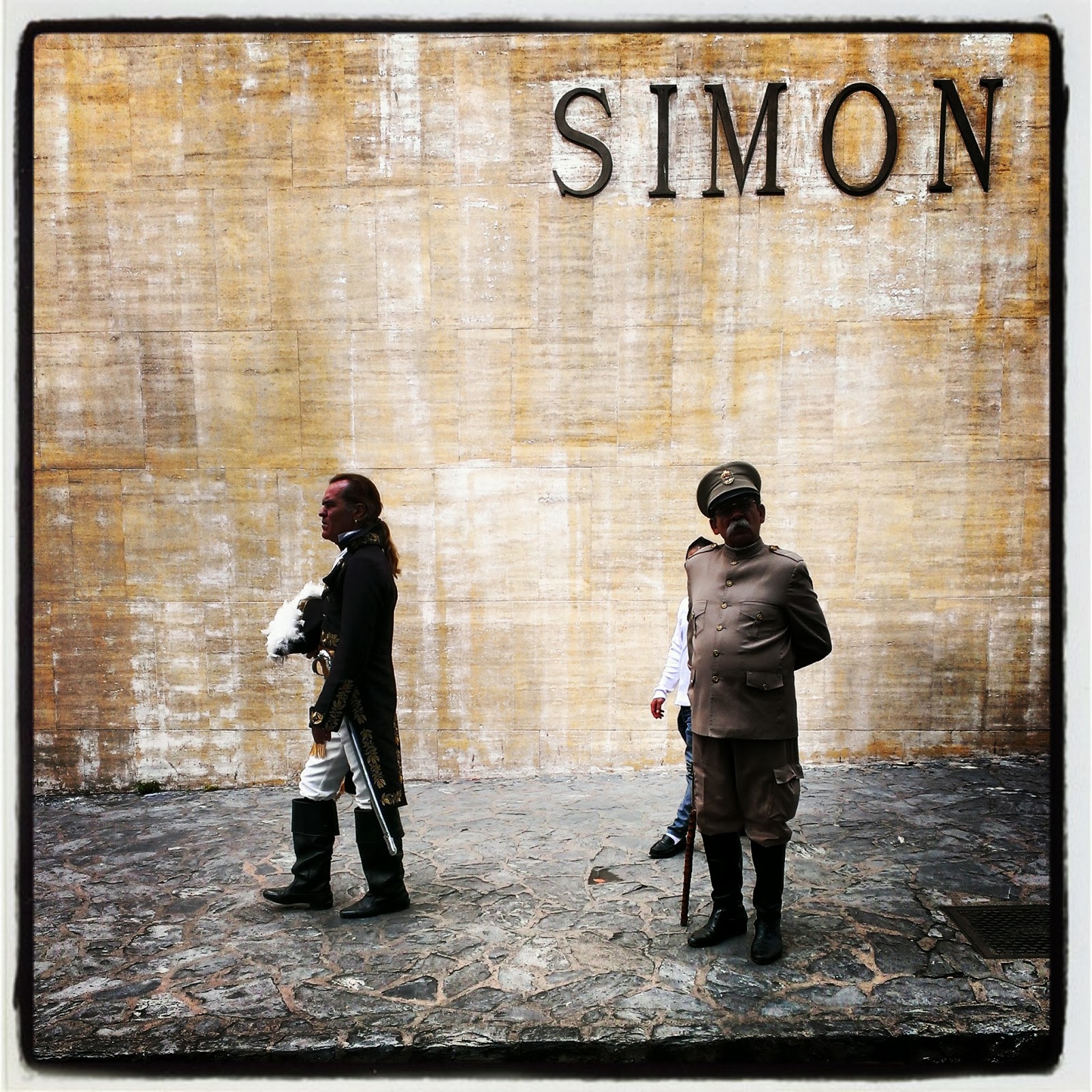
Street Theatre: In the area around Plaza el Venezolano and Plaza Bolivar in the centre of Caracas, actors recreate key scenes from Venezuela's history by bringing to life famous characters from the past who tell the story of their time. Here, the dictator Juan Vicente Gomez takes a stroll with Independence hero Francisco de Miranda.  


Whitewater Rafting: On the Rio Acequias in Barinas, adventure tour company Arassari Trek took us on a bumpy, adrenaline-pumping ride down a Grade III stretch of foaming rapids. It helps if everybody rows together. For more details of rafting in Barinas contact Arassari Trek


Remote Andean Villages: Just outside San Jose de Acequias, one of the so-called Pueblos del Sur, we came across this tiny chapel dedicated to San Isidro Labrador, the patron sain of farmers. 


Vibrant Folk Festivals: The Locainas de Santa Rita are gentlemen who dress like ladies for a day during the festivities in honor of San Isidro, as Santa Rita in popular lore is the wife of the saint. As their name suggests, these ladies can get quite "loco" during the festivities held on 21-22 May, and after dancing with their sticks they try to liven up the festive mood by flirting with the men in the crowd.


Paragliding in Merida: Tierra Negra, close to the Andean city of Merida, is one of the best paragliding spots in Venezuela. Jose Albarran of Fanny Tours is one of the pioneers of paragliding in Venezuela and a great pilot for a tandem flight. Known to his friends as "Piojo" (Flea), due to his uncanny ability to scale sheer rock faces, Jose is one of the founders of the paragliding school in the nearby village of Las Gonzales, close to the landing site. The youngsters of La Gonzalez are now being trained to become the paragliding champions of the future. Watch a video of me paragliding with Piojo here

For more details of paragliding in Merida contact Jose at Fanny Tours

Thursday, December 6, 2012

Venezuela's Dancing Devils make UN World Heritage List


Venezuela's historic and very unique tradition of masked devil dancing, known as the Diablos Danzantes, which takes place in some 14 towns and villages each year to celebrate the Catholic Feast of Corpus Christi, has been chosen by the UN Educational, Scientific and Cultural Organization (UNESCO) for inclusion in its List of Intangible Cultural Heritage in Need of Urgent Safeguarding.

The other six traditions chosen included: a chanted form of oral poetry practiced by the Bedouin of Oman; the Fiesta de Patios in Cordova, Spain, which preserves traditional songs and dance; the Mesir Macunu festival in Turkey, which commemorates the recovery of the mother of Suleiman the magnificent from a disease; the elaborate process of creating Romanian Horezu ceramics; and the practise of falconry in Austria and Hungary.

The decision to include Venezuela's foremost folk tradition on its list came after a week-long meeting of the UNESCO Cultural Heritage Committee at the UNESCO headquarters in Paris.

The UN-body hopes that by highlighting disappearing traditions in this way it can help prevent them from fading into extinction and protect the world’s intangible cultural heritage for future generations.

The spectacular masked dancing festivals celebrated in Venezuela on the moveable feast of Corpus Christi (the 9th Thursday after Holy Thursday) continue a centuries-old tradition brought from Spain.

In the country's sugar and cacao plantations, where large numbers of slaves were brought from Africa to sweat for Spanish masters in the fields and forests, the masked dances took on a special significance.

They represented an inversion of the usual power relationship between master and slave, when men with masks to hide their faces took over the town and made mischief without fear of retribution. It was also the one day when a group usually barred from entering the church during Sunday mass could express its defiance and rejection of the status quo.

Nowadays, people dance as a way of requesting a favour from God, to help a sick family member or to resolve a difficult situation for the family. The men who have asked for this intervention are called "promeseros" ("pledgers") because they make a solemn pledge to dance in the festivities every year for a certain number of years or for life, known as "pagando promesa" ("paying the pledge").

The devil dancing begins the day before Corpus Christi with a meeting of the Devil Dancer's Confraternity, private dances and blessing ceremonies with holy water, scapulars, amulets and prayers to protect the men and boys who are about to dance from any spiritual harm.

From sunrise the devils parade through town, dancing around to the sound of cuatro (four-stringed guitar like a ukelele) and maracas, and causing mischief, mayhem and general devilment. About midday, the masked devils gather in front of the church, led by the chief devil and his whip-wielding capataz (overseer). In front of the gathered crowds, they make a mock attack on the church that is repelled by the priest holding aloft the consecrated hosts of the eucharist.

Three times the devils attack and three times they are repelled. Finally, with good having triumphed over evil the devils prostrate themselves before the host. With their masks now removed, the devils continue to dance through the streets and the party begins in earnest.

The most celebrated devil dancers are in San Francisco de Yare, which is close to Caracas in the Valles del Tuy. Dressing from head to foot in red, the Yare devils carry maracas and wear multicolored horned masks made from papier mache.

In the coastal cacao plantation of Chuao, famous for its high-quality cocoa beans, isolation has helped preserve many early elements of devil dancing, including costumes made of colored rags and black and white masks rooted in African traditions.

Further Information:
The Dancing Devils of Yare in Literature

How the Dancing Devils of Yare Got Their Distinctive Red Costumes

Short Documentary on the Dancing Devils of Chuao


Friday, October 26, 2012

Venezuelan Folk Saint Jose Gregorio Hernandez is 148


Venezuelans will be lighting a candle today for the country's most popular folk saint, Dr Jose Gregorio Hernandez, who was born on 26 October 1864 in the small Andean pueblo of Isnotú, Trujillo State.

The good doctor spent his short lifetime helping the poor and performing miracles until he was tragically killed on 26 June 1919, run down on the corner of Amadores and Uparal in Caracas by one of the first cars in the city. 

Since then, millions of Venezuelans have prayed to a small statue of Jose Gregorio Hernandez, or carried a printed image of him to help overcome illness or bad health for themselves or family members.

His tomb in the church of La Candelaria, Caracas, and his birthplace in Isnotú are popular places of pilgrimage, especially by the sick and infirm seeking a miracle cure.

The many claims of miraculous healing attributed to Jose Gregorio Hernandez over the years led Pope John Paul II to declare him "venerable" in 1986 - an important step on the road to sainthood.

But devotion to "El Medico de Los Pobres" (The Doctor of the Poor) or "El Siervo de Dios" (The Servant of God), as he is known, extends beyond the Catholic Church. 

Statues, prints and scapularies of Jose Gregorio Hernandez - depicted in a black suit and hat with a Charlie Chaplin moustache, or in a doctor's white coat.- are sold outside and inside some churches.

You can also find them in stores known as perfumerías (literally perfume shops), which sell a dizzying array of soaps for washing away bad luck and love potions to make you irresistible, alongside shelves of statues of saints and characters from the Cult of Maria Lionza.


Tuesday, October 2, 2012

Culture Smart! Venezuela - My New Book is Out


Culture Smart! Venezuela - My new book about Venezuelan culture, language, history, music, jokes, business etiquette and travel comes out a few days before the presidential election.
Can't believe it's here. Can't wait to do the update already.

To purchase on Amazon.co.uk click here: